
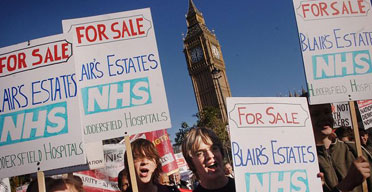
Tony Blair was forced on to the defensive today over Labour's record on the NHS, as hundreds of health workers and patients lobbied parliament over job losses and privatisation.
A mass demonstration called by the 16 NHS unions under the umbrella group NHS Together was timed to coincide with prime minister's questions at midday.
There Mr Blair rejected accusation from the Conservative leader, David Cameron, that NHS morale was a rock bottom.
The prime minister said that even the Tories admitted that there had been "improvements" to the NHS under Labour.
He told MPs: "Let me tell you what is actually happening in the NHS.
"There are 400,000 fewer people on waiting lists than in 1997, waiting times for cataracts and heart operations are down, people now get their cancer treatment on time, there are 300,000 more staff in the NHS."
Mr Cameron, who has launched a Tory campaign against NHS cuts, quoted the government's chief medical officer, Sir Liam Donaldson, as saying that "evidence from within the NHS tells a consistent story for public health of poor morale, declining numbers, inadequate recruitment and budgets being raided to solve financial deficits".
Mr Blair ignored that claim, but conceded there were "real difficulties in the NHS".
NHS Together claims that up to 20,000 jobs will be lost this year.
The government puts the figure at 900 actual redundancies, with other cuts coming through retirement, wastage and voluntary redundancies.
The mass lobby of parliament will take three hours, and will be addressed by Dave Prentis, the general secretary of the largest health union, Unison.
The rally will also be joined by the campaign group Keep Our NHS Public, and the National Pensioners Convention.
But Andy Burnham, the minister for quality and patient safety in the Department of Health, warned demonstrators in advance that there would be no "drop in the pace of change" in the NHS.
He said that the enlargement of private provision within the health service had only one aim: "ending waiting in the NHS as we know it." Mr Burnham told BBC Breakfast: "If the issue is drop the direction, drop the pace of change, I would say 'no' to that because it is all geared towards a very specific goal and that goal is ending waiting in the NHS as we know it.
"I think it is a huge goal to strive for, for everybody who believes in the NHS.
"Actually, rather than putting the NHS under any threat, this is the NHS poised to make one of its biggest leaps forward in its history."
At last year's election the government promised to cut all waiting lists to a maximum of 18 weeks from first referral by a GP by the end of 2008.
Fulfilling this meant "cracking on" with reforms and using the private sector where it could help the NHS, he said.
A spokesman for Keep Our NHS Public, a campaign group launched in September last year, said: "Patricia Hewitt's crowning achievement as health secretary has been to unite the NHS against her.
"Thousands of people are coming together to express what is happening to health care in their own parts of the country."
But, in a statement, Ms Hewitt said that change in the NHS was inevitable to ensure "better quality care".
She said: "If we know that change will deliver better quality care and better value for money for taxpayers, then standing still is simply not an option.
"However, what will never change is our commitment to safeguard NHS values."
She added: "The NHS is now working to improve healthcare further, with more care closer to home, delivered more productively.
"We are not apologetic about asking the NHS to deliver better quality care and best value for money to the taxpayer."
A YouGov survey published today said that half of voters thought that the NHS had declined since 1996, although Mr Burnham countered that the same poll found that 65% of personal experiences of the NHS were positive.
Government polling by the Healthcare Commission found that nine out of ten people rated their own treatment as "excellent, good or very good", he added. An NHS Together spokesman said: "We are very worried that the NHS is being fragmented, with a rapid dash to the private sector and the introduction of competition.
"The government should do more to recognise the progress made by their extra money and our hard work, and should make sure that change and reform involves the staff who will have to deliver it."
After the march and lobby of parliament, campaigners will gather in Westminster Central Hall to listen to speakers.
These are set to include Karen Jennings, head of health at Unison, Jacky Davis, consultant radiologist at the British Medical Association, and Beverly Malone, general secretary of the Royal College of Nursing.
The Tories emblazoned their recent party conference with placards of the chancellor, Gordon Brown, wielding scissors and urging the public to "Stop Brown's NHS cuts."
The Liberal Democrats' health spokesman, Steve Webb, said that the lobby showed the depth of opposition within the NHS to the government's "rushed" reforms.
"The job cuts confirmed by the government this week are only the tip of the iceberg; how many jobs have been lost to recruitment freezes and compulsory retirement?
"We will not see the true level of job losses across the NHS until hospitals have finished consulting on their reconfigurations.
"Ultimately it is patient care which will suffer through these cuts in services and staff."
